

98989 49719
Ground Mounted EPC
What is a Ground-Mounted Solar Project?
Optimal Sun Exposure
Scalability
Durable Construction
Flexibility
Land Utilization
Higher Energy Output
Long-Term Performance
Tracking Systems
Scalable, Reliable, and Cost-Effective Clean Energy
- Ground-mounted solar systems can be installed at optimal angles and positions to capture maximum sunlight throughout the day, leading to higher energy efficiency and greater electricity production.
- Unlike rooftop systems, ground-mounted solar panels are less likely to experience shading issues from nearby buildings or trees, ensuring consistent energy generation.
- These projects are scalable, meaning they can be expanded by adding more solar panels as energy demands increase, making them ideal for large-scale installations.
- Ground-mounted solar projects make use of unused or underutilized land, converting it into a valuable resource for renewable energy generation, without disrupting existing infrastructure.
- Over time, ground-mounted solar systems reduce reliance on conventional energy sources, which can lead to significant cost savings for businesses and large-scale power producers.
01 Land Documentation
02 Project Planning
03 Design and Engineering
04 Procurement & Construction
05 Operation and Maintenance
What is a ground mounted solar power plant?
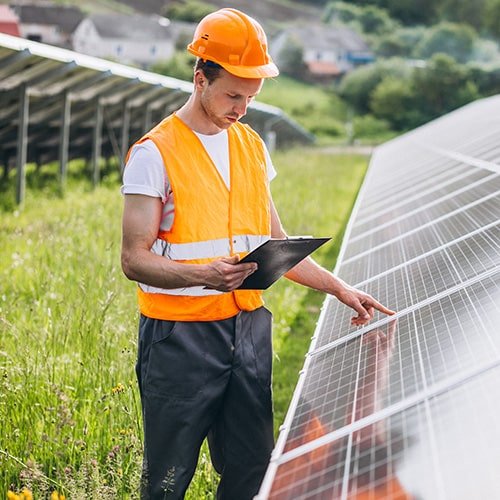
A ground mounted solar power plant is a photovoltaic (PV) system installed directly on land, as opposed to rooftops. It consists of solar panels mounted on frames anchored to the ground, converting sunlight into electricity for grid or captive use
What are the main benefits of installing rooftop solar at home?
Key benefits include significant cost savings on electricity bills, access to clean and renewable energy, reduced dependence on fossil fuels, lower carbon footprint, and eligibility for government subsidies and incentives
What government subsidies are available for residential rooftop solar in India?
Under schemes like the PM Surya Ghar Muft Bijli Yojana, the government offers subsidies ranging from Rs. 30,000 to Rs. 78,000 for residential solar installations, covering up to 40% of the installation cost. Additional state-level subsidies may also be available
What is the typical payback period for a residential rooftop solar system?
With current subsidies and electricity savings, most residential rooftop solar systems in India have a payback period of 4–6 years. After this period, the electricity generated is effectively free for the remaining life of the system (typically 20–25 years)